Your First Time Playing Poker at a Casino: The Chip Rules a Home Game Never Taught You
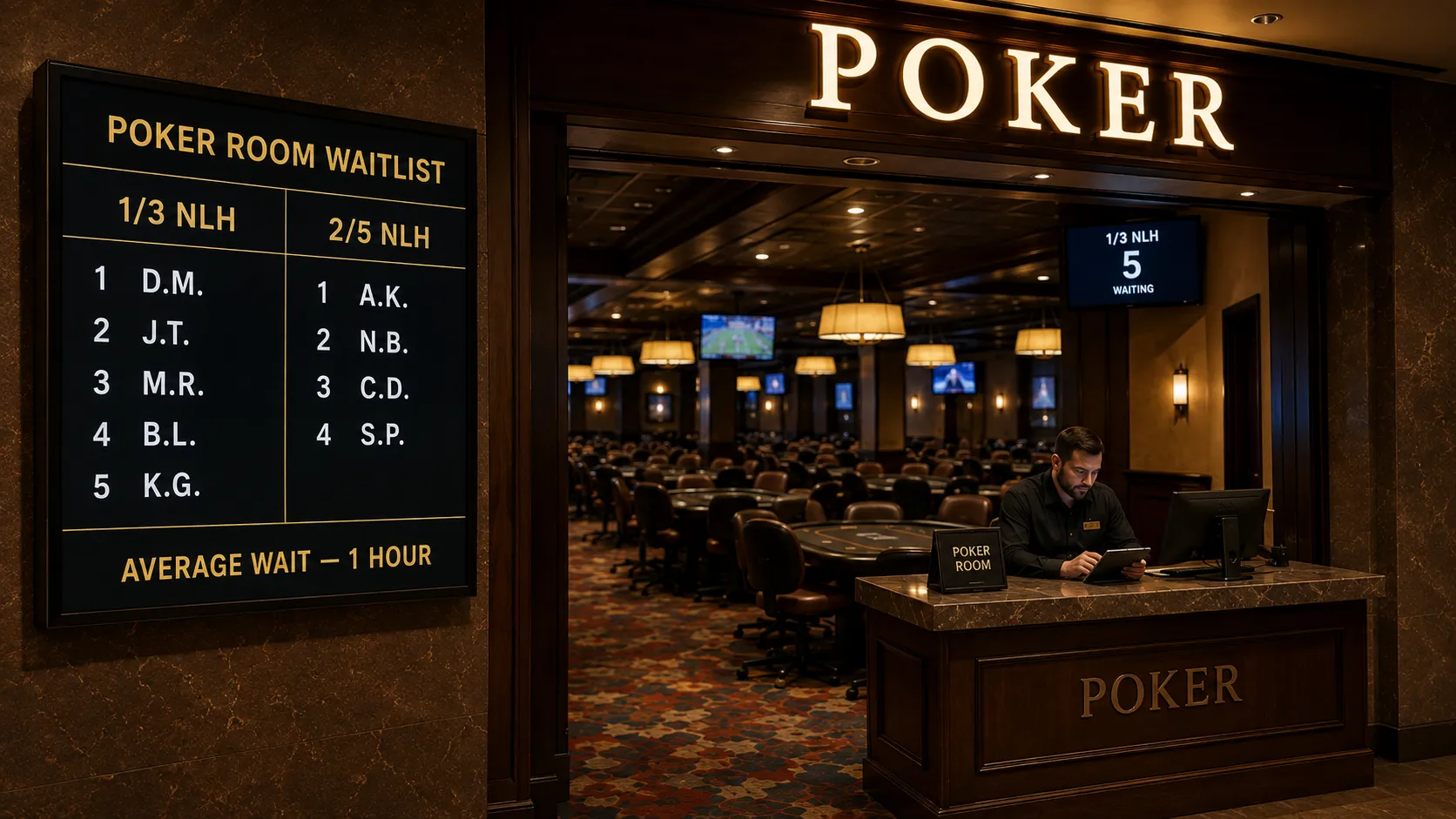
A friend of mine had been playing home games for a few months when he decided he was ready to play his first casino poker game. We agreed to meet at a local casino at 7 p.m. What I forgot to tell him: get on the waitlist first.
I had the app installed and had joined the waitlist about an hour earlier. My friend, however, had no idea that a waitlist even existed. He happily showed up at 7 p.m., ready to sit down and play, only to be told by the poker room that the wait would be about an hour.
He was fairly annoyed with me. The beer after the game was on me.
But it got me thinking: what other things do experienced casino players take for granted that can completely catch out someone coming from home games? About an hour later, when my friend finally joined me at the table, I kept an eye out for the things that tripped him up. It also jogged my memory of some of the things I had to learn during my first few casino sessions.
He didn’t run into every one of these situations that night, but I thought it would be useful to capture as many as I could and share them with him before his next session. He finished the night up, and was already asking when we’d go back.
The poker itself wasn’t the problem. The casino was a whole new environment around the poker.
If you’re used to home games and are about to play your first live casino cash game, here’s what actually tends to go wrong.
The things that catch out a home-game player in their first casino session are almost never strategic. They’re mechanical — how you move your chips, whether you said anything before you moved them, and whether your cards are covered. A single oversized chip pushed out silently is a call, however large it is. A bet made in two motions is a string bet. An unprotected hand that gets mucked is usually gone for good. And the house is taking money out of every pot in a way no home game does. Announcing your action out loud, before your chips move, prevents most of it.
1. Getting to the Casino: Join the Waitlist and Know What to Expect
This was the first lesson of the night. Most casino poker rooms have a waitlist for popular games, particularly on weekend evenings. If you simply walk into the casino and expect to sit down immediately, you may end up spending a significant part of your evening waiting.
The casino I frequent uses the PokerAtlas app to manage its waitlists. I can use it to join the games I want, see how many tables are running and check how many players are waiting.
There are also rules around how long you have to show up and check in after joining the list. At my casino, for example, I have 90 minutes after joining to check in, and the app uses my location to make sure I’m close enough to the casino.
Your casino may work differently. Some rooms use other apps, while others will simply let you call the poker room and get on the list.
💡 Live poker tip: Call the poker room before your first session. Ask whether they use a waitlist, which app they use, whether you can join by phone, and how long you have to check in after joining.
It’s a two-minute phone call that could save you an hour of sitting around.
What if you’ve never played in a casino before?
This is another thing that can make a first session feel more intimidating than it needs to be. If you’ve only played home games, there will be things at a casino that you don’t understand. That’s completely normal.
You might not know how the table works, when you’re supposed to post a blind, what a particular announcement means, or whether you’re allowed to make a particular action.
If it’s the vocabulary you’re worried about, I wrote a separate piece on the words they’ll say at a live table — though the short version is that most of them cost you nothing to not know. And if it’s that last one — whether you’re allowed to do something — that’s the handful of terms that are really rules.
Ask the dealer.
Dealers see new players all the time. If you’re unsure what to do, it’s much better to ask the dealer before you act than to make a guess and find yourself in an awkward situation.
You don’t need to announce to the entire table that you’ve never played casino poker before. But there’s also no shame in quietly telling the dealer that it’s your first time in a casino game. Most of the things below are easy to learn once you’ve seen them happen once.
2. The One-Chip Rule: Your Raise Might Be a Call
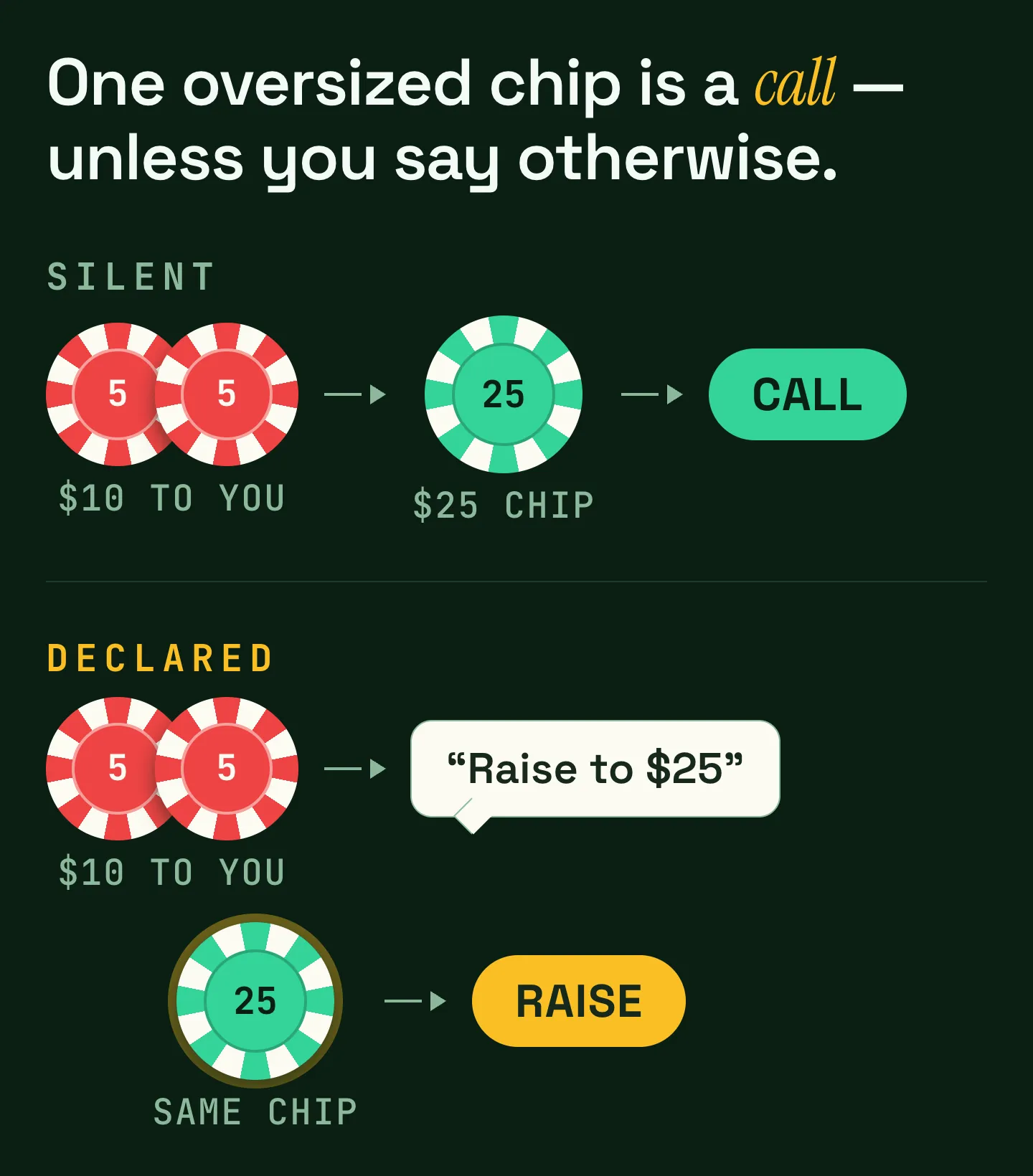
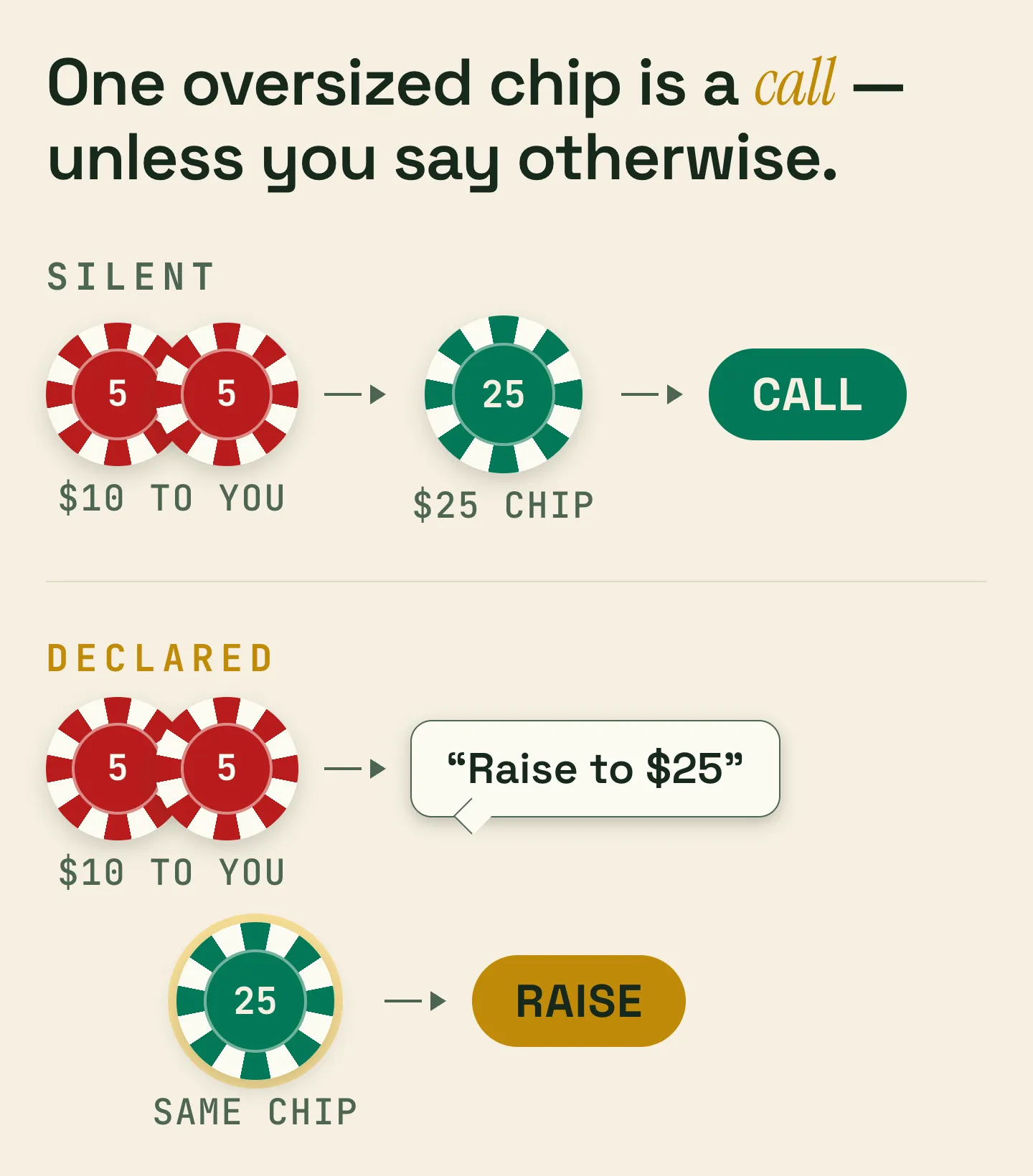
You made it to the casino, bought your chips and are finally seated at the table. A couple of orbits in, you get a playable hand. It folds around to you, and you decide to raise. You confidently put a single green $25 chip into the pot. The dealer says, “Call,” and points to the next player. You look at him incredulously.
“But I raised.”
And that’s when you meet the one-chip rule. Putting a single oversized chip into the pot without announcing a raise is treated as a call. For example, if the current bet is $10 and you silently put in a $25 chip, you haven’t automatically raised to $25. You’ve called the $10, and the dealer will push $15 back to you as change. It would still be a call even if you used a $100 chip.
The easiest way to avoid the one-chip rule
The simplest solution is also one of the best habits you can develop as a live player:
Say what you’re doing before you do it. “Call.”
“Raise.”
“Raise to $25.”
Saying it out loud removes the ambiguity before it can start. You can also avoid the one-chip problem by putting out multiple chips when raising. For example, five $5 chips to make $25 is clearly different from putting out a single $25 chip. The same principle matters when you’re facing an all-in. If you intend to call, simply say “call” before putting your chips in.
3. String Bets: Declare, Then Stack
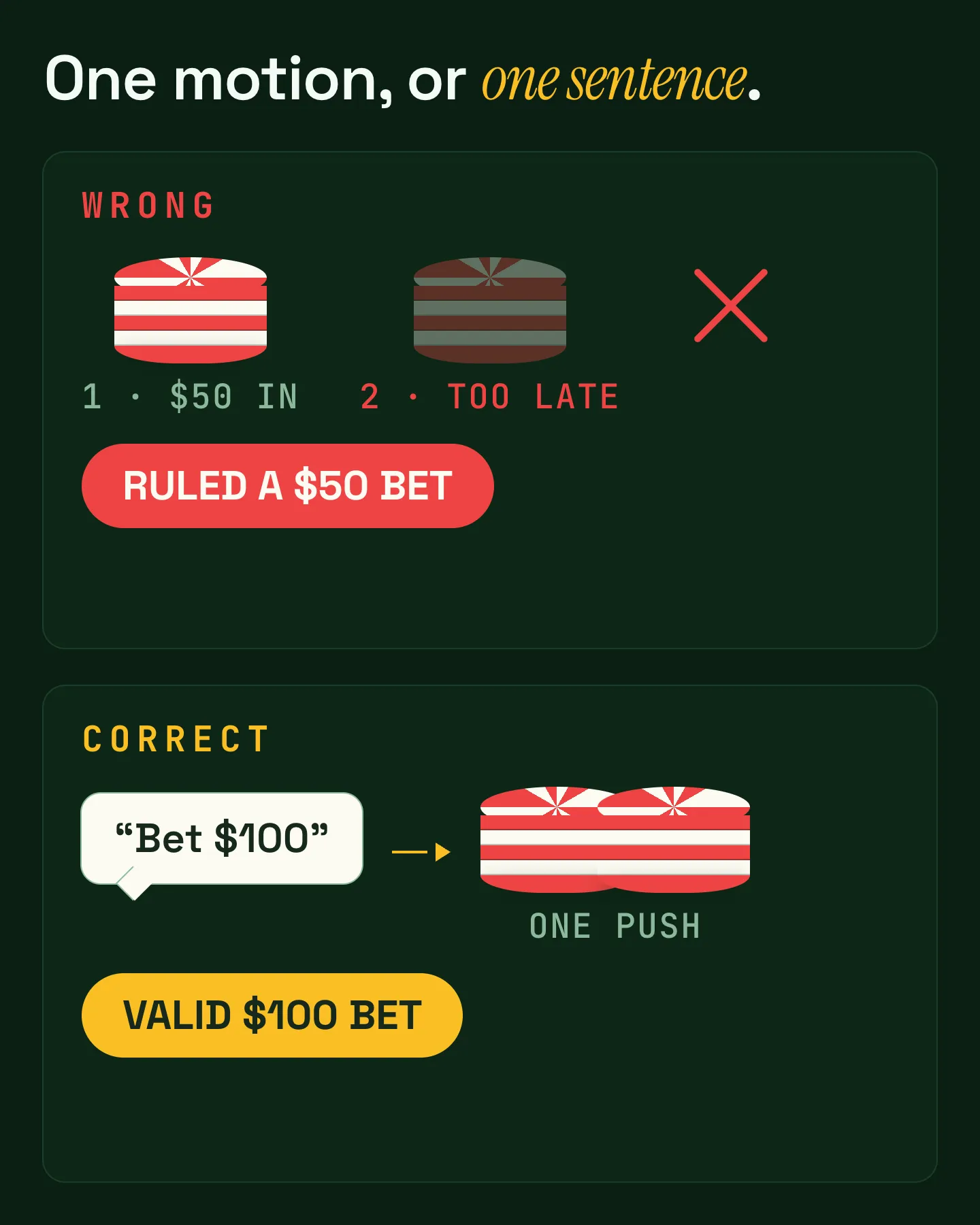
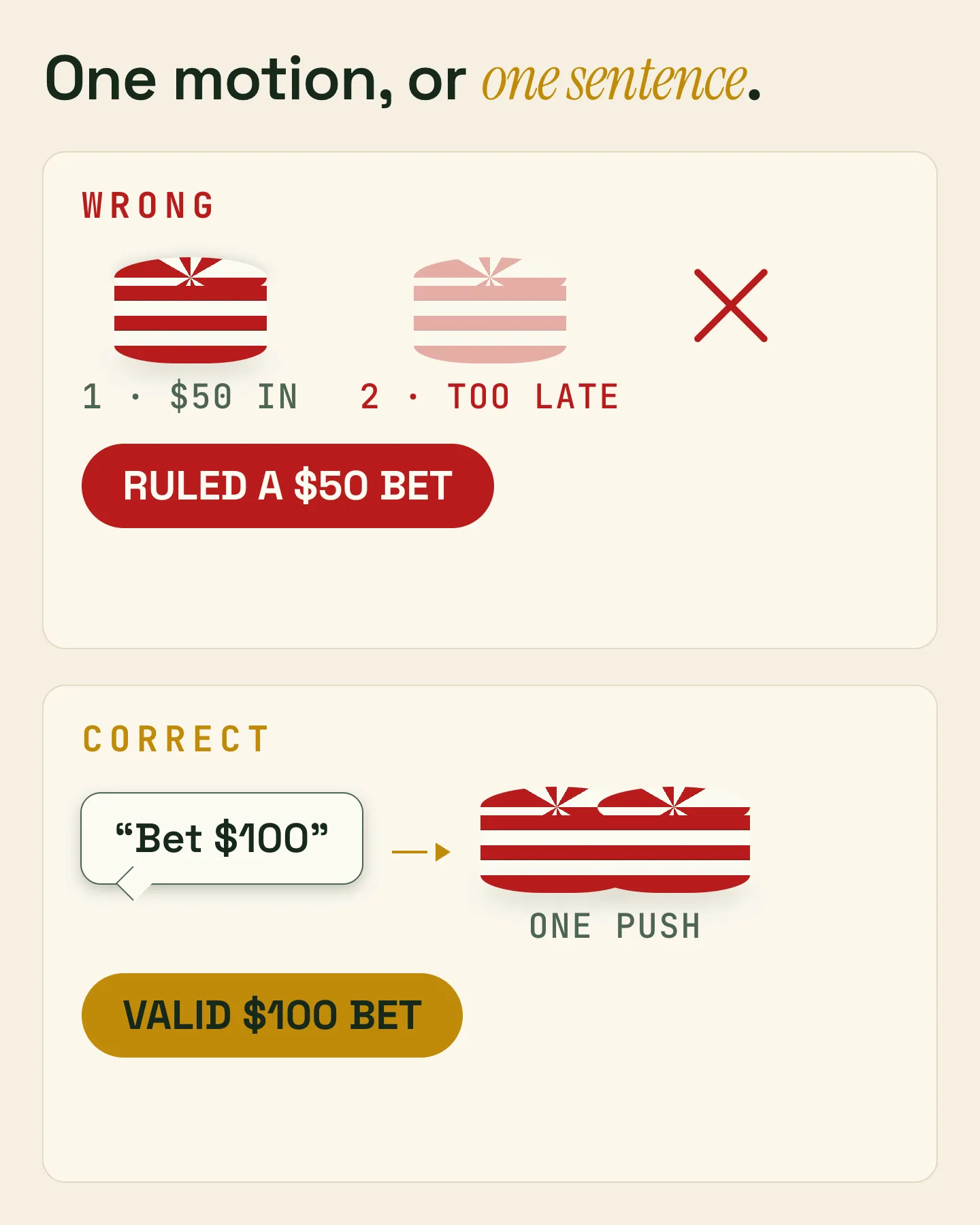
I remember a player wanting to bet $100 on the flop. He counted out two stacks of $50 in red chips, pushed the first stack forward, and then went back to his stack for the second. The dealer immediately stopped him and pushed the second stack back. He clearly hadn’t intended anything improper, and everyone at the table knew it. It didn’t matter.
This is a string bet: putting chips into the pot in separate movements without clearly declaring the full action first.
The reason for the rule is straightforward. If you put some chips in, then pause and reach back for more, you could potentially watch the other players’ reactions before deciding how much more to commit.
The easiest way to avoid the problem is to remember:
Declare, then stack.
If you want to bet $100, say “bet $100” before moving your chips. If you want to raise, announce the raise and the amount the same way. Once you’ve said the amount out loud, it’s binding — you’re committed to it whether your chips have arrived yet or not. That’s what makes it a fix rather than a formality: the words settle the action, so the chips can follow at whatever pace you like.
It’s a small habit, and it saves you an awkward first-session moment.
4. Protect Your Hand
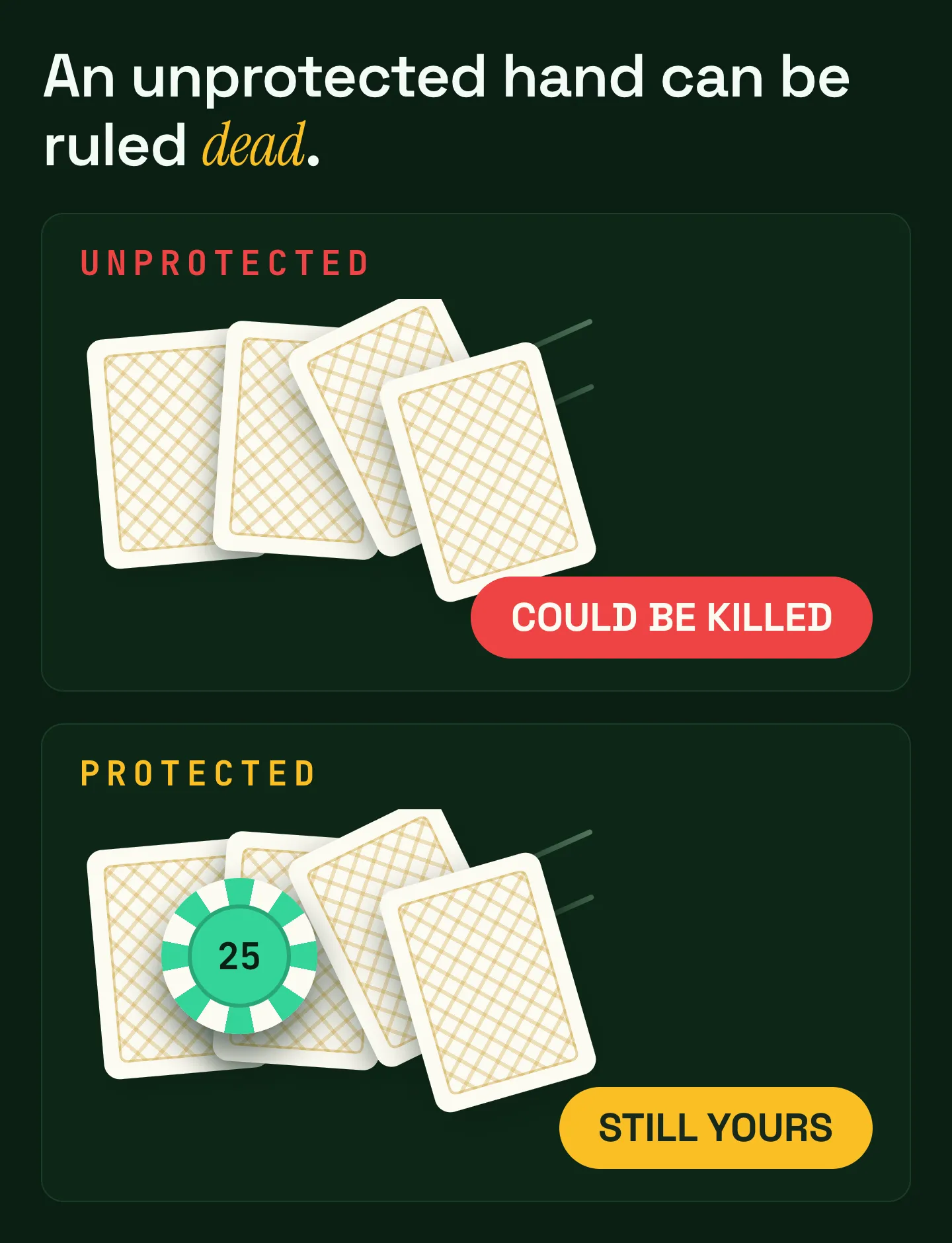
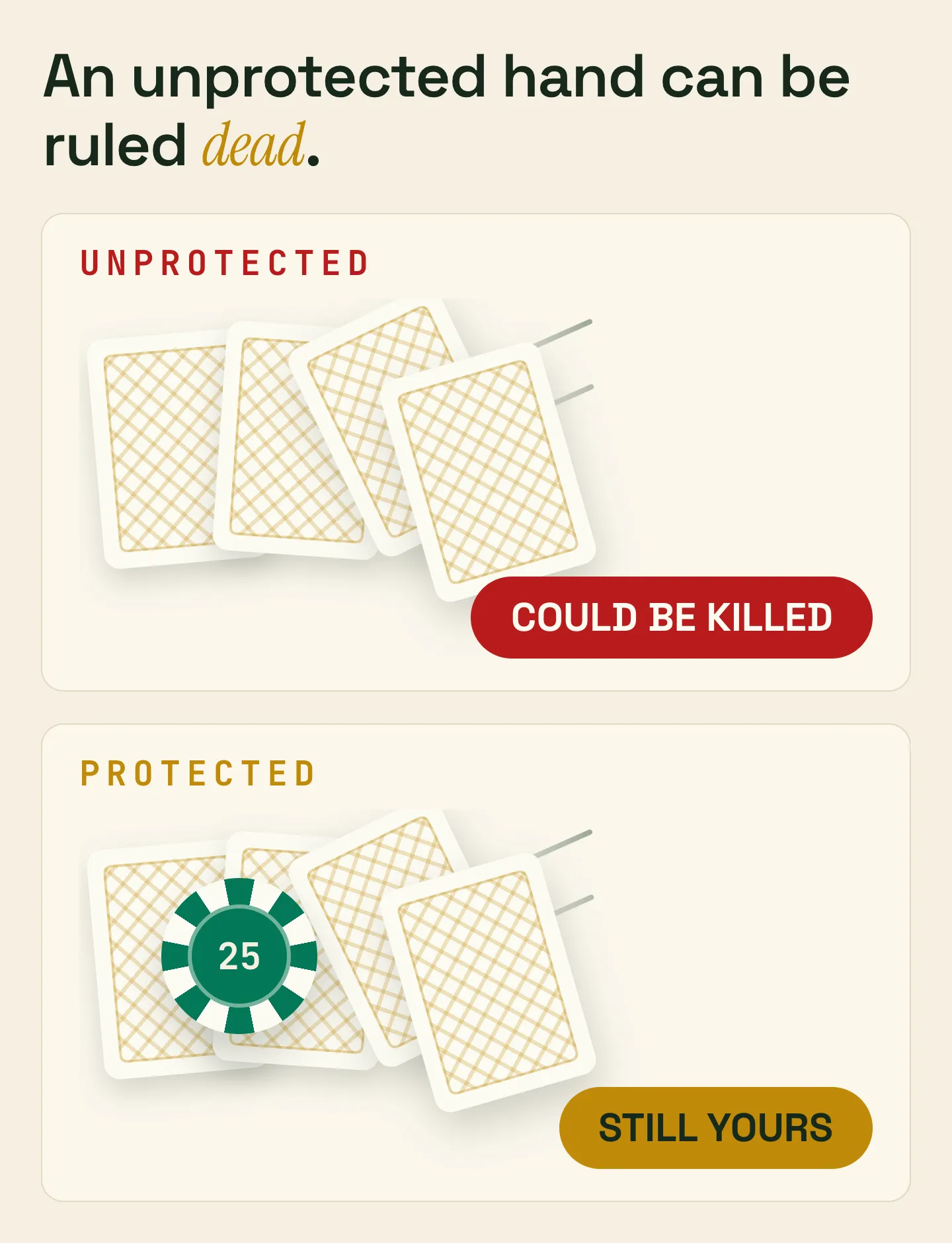
In a recent game, the player acting before me threw their cards toward the dealer in frustration when they folded. The cards landed on top of mine. Thankfully, I had a chip sitting on my cards. Without it, my hand could have been mistaken for the discarded one and killed.
This doesn’t require a careless dealer. Dealers are working quickly, handling multiple hands and watching the action around the table. Your cards can get mixed up surprisingly easily.
And once your cards have gone into the muck, there’s usually no way to get them back — even if you were holding the winner. That’s why live players use card protectors. You don’t need anything fancy — I’ve seen people use everything from stones and tokens to figurines and whatever they happened to have in a pocket. A chip works perfectly well.
💡 Live poker tip: If you’re in a hand, put a chip on your cards.
You don’t need a special card protector. A $1 chip does the job.
But if nothing else, remember:
Protect your hand.
5. Live-Table Etiquette: Chips and Acting Out of Turn
Keep Your Bigger Chips Visible
In a home game, everyone usually knows roughly how much everyone else has.
In a casino, your opponents need to be able to size up your stack by looking at it. That means you shouldn’t bury your higher-denomination chips underneath a pile of smaller ones. If your $25 or $100 chips are hidden behind your red $5 chips, another player can’t easily tell how much you have.
Keep your bigger denomination chips visible, typically toward the front or top of your stack. If another player or the dealer asks you to move your chips so they can see them more clearly, just do it. It’s not an accusation — it’s part of making sure everyone at the table can see the stacks involved in a hand.
💡 Live poker tip: Make your stack easy for everyone to read.
Your opponents shouldn’t have to ask you how much you have behind before making a decision.
Don’t Act Out of Turn — and Speak Up If Someone Does
Acting before it’s your turn is another easy mistake for a new live player to make. It gives information to the other players and, depending on what happened, your action may or may not stand.
The important thing for a new player isn’t to memorize every ruling. It’s to develop one simple habit:
Pay attention to whose turn it is.
And if someone acts before you, speak up immediately. If the player on your right bets when you’re supposed to act first, don’t just sit there and let the hand continue. Say:
“I’m still to act.”
There are rules specifically dealing with out-of-turn actions, and the exact ruling can depend on what happened next. But one principle is particularly important for new players: you have a responsibility to defend your right to act.
And there’s an asymmetry worth remembering:
You may be able to undo an action made out of turn. You generally can’t undo a fold once you’ve made it.
So don’t be shy about speaking up.
6. Chopping the Blinds: What Does It Actually Mean?
If everyone folds around to the two blinds, the players may agree to “chop.” Instead of playing the hand heads-up, they return the blinds and move on to the next hand.
I watched players do this for a while before I understood what was happening. Eventually, I asked the regular sitting next to me, and he explained it.
What I didn’t ask was why anyone would want to.
I was embarrassed to ask that one out loud at the table, so I looked it up later.
One common reason is the rake. Many casino poker rooms have a “no flop, no drop” policy. In these rooms, the house takes a percentage of the pot — the rake — when the hand reaches the flop. If everyone folds before the flop, the house takes nothing.
So if the blinds are heads-up and agree to chop, they can avoid playing a tiny pot where a significant portion may otherwise go to the house.
The exact rules and conventions vary between poker rooms, so if you’re unsure, ask the dealer.
You’ll see some players who always chop and others who never do. Promotions can also affect how players approach blind-versus-blind situations.
For your first session, the important thing is simply to know what the conversation means.
If the other player asks:
“Chop?”
You can say yes or no. You don’t need to understand every strategic consideration behind the decision on your first night.
7. Calling the Clock: Yes, You Can Do It
If someone is taking an unreasonable amount of time to make a decision, any player at the table can ask the floor to put a clock on them.
The first time you see this happen, it can feel surprisingly confrontational.
It isn’t necessarily.
A clock is just a way of limiting how long someone has to make their decision. The exact procedure and timing vary between rooms, and between cash games and tournaments, so you don’t need to memorize every rule before your first session.
There’s also a social side to it. Calling a clock is effectively telling someone that you think they’re taking too long, and the table will notice who called it.
I’ve seen a player call the clock on himself because he was stuck in a decision and wanted the countdown to force him to act. I thought that was a genuinely clever use of the rule.
I’ve also seen someone get angry when another player called the clock on him, with the rest of the table sympathizing with the player who was taking too long.
The useful lesson for a new player is simple:
💡 Know that the clock exists. You don’t need to be afraid of it — but you probably don’t need to be the person calling it during your first few sessions.
Knowing the rule is not the same thing as feeling comfortable using it.
8. Poker Rake: The Cost Home-Game Players Often Forget
There’s one major difference between most home games and casino poker that can be easy to overlook:
The casino is charging you to play.
In a typical cash game, the casino takes a percentage of pots as a rake, up to a maximum amount.
Some rooms also have separate promotional or jackpot drops. Others use a time-based collection instead of taking a percentage of every pot. The details vary significantly between casinos, stakes and locations.
Before you sit down, it’s worth asking the floor:
- What is the rake percentage and cap?
- Is there a separate promotional or jackpot drop?
- Is it “no flop, no drop”?
- Is this a time-based game instead, and if so, how much is collected and how often?
Nobody will think less of you for asking. You’re only asking how much the game costs.
Why Rake Matters at Small Stakes
I didn’t think much about rake for a long time. At the time, I wasn’t particularly concerned about its impact on my win rate.
In hindsight, that’s a bit like not being concerned about the interest rate on a loan.
Rake is especially important at small stakes because it can represent a meaningful percentage of a player’s potential winnings.
A 2019 analysis by Steve Selbrede for PokerNews, using tracked cash-game data, found an average $1/$2 rake of $2.16 per hand and average rake paid per player of $9.86 per hour. Those figures are historical and rake varies significantly between rooms, so they shouldn’t be treated as a current universal number.
The broader lesson is more important than the exact figure:
Know what your game costs.
And remember that becoming a better player doesn’t just mean winning more pots. It means understanding the costs you’re playing against and identifying the leaks in your own game.
That’s part of why I built HeroCall — you describe a hand the way you’d tell a friend at the bar afterwards, and get a straight read on where the money actually went. Rake you can’t do much about. The leaks you can.
Your First Casino Poker Session: A Quick Checklist
If you’re about to play your first casino cash game, you don’t need to memorize this entire article. Save this checklist instead.
Before you arrive
- Check whether the poker room has a waitlist.
- Find out which app the room uses, if any.
- Join the waitlist before you arrive when possible.
- Check how long you have to show up and check in.
- Know what stakes and game you’re joining.
When you sit down
- Don’t be afraid to tell the dealer you’re new.
- Ask if you’re unsure about a procedure.
- Keep your larger denomination chips visible.
- Put a chip on your cards when you’re in a hand.
During the hand
- Pay attention to whose turn it is.
- Announce your action before moving your chips.
- Remember the one-chip rule.
- Declare, then stack to avoid string bets.
- Speak up immediately if someone acts before you.
Before you start playing regularly
- Understand the rake.
- Ask about promotional or jackpot drops.
- Find out whether the room uses “no flop, no drop.”
- Understand the room’s conventions around chopping.
The Casino Isn’t as Intimidating as It Looks
Looking back, none of these things are particularly complicated.
But that’s exactly the problem.
When you’ve only played home games, you don’t know which things you’re supposed to know.
You know how to play poker. You just haven’t learned the casino version of everything around the poker.
So before your first session, remember a few simple rules:
Get on the waitlist.
Ask the dealer if you’re unsure.
Announce your action before moving your chips.
Declare, then stack.
Protect your cards.
Keep your bigger chips visible.
Pay attention to the action.
Ask about the rake.
And most importantly, don’t worry about looking like a beginner. Every regular at the table was new once.
The goal of your first casino session isn’t to know every rule before you sit down. It’s to get through those first few sessions without being surprised by something you could easily have known in advance.
Once you get past that, the casino starts feeling a lot more like the home game you already know.