Poker Terms That Are Really Rules: Straddle, Min Raise and Short All-Ins
When I first started playing live poker, I assumed that learning a poker term meant learning what the word meant. Most of the time, that’s true. A flop is a flop. A gutshot is a gutshot. A 3-bet is a 3-bet. Then I ran into the terms that aren’t quite that simple.
A straddle, for example, isn’t just a blind bet. Depending on the room, it can change who acts first. A minimum raise isn’t simply a raise that has to be twice as big. And an all-in doesn’t always mean that everyone else can raise again. I learned some of these rules by getting them wrong at the table.
Those are the poker terms I wish I’d understood a little earlier — not because they’re difficult, but because sometimes the definition isn’t the important part. What matters is what you’re allowed to do next.
If you’re still getting comfortable with the basic poker vocabulary, it’s worth starting with Poker Terms for Beginners, which covers the everyday language you’ll hear at the table. Once you have that down, these are the terms where things get a little more interesting.
A straddle is not one rule — it depends on the room
A straddle is a voluntary blind bet posted before the cards are dealt. In many live games it’s twice the big blind, but the size and rules can vary by room.
The first time I saw one, the obvious question was the one everybody has: why would anyone bet without seeing their cards?
People straddle to make the game bigger, and — usually — to act last before the flop. Whatever the reasoning, the practical effect is the important part: a straddle makes that hand play like a bigger game than the one you sat down in. A $1/$3 game with a $6 straddle is, for that hand, closer to $3/$6.
The second surprise came later, and it’s the one that actually matters.
I had learned what a straddle was, and it still didn’t tell me whose turn it was.
I played in a $1/$3 game where the button straddled. In that casino, action started with the small blind and the button would eventually get the last action preflop.
A few days later, I was in another casino where the button straddled again. This time the order was different. Action went around the table, skipped the button, and came back to the button after the blinds had acted.
In the first room the blinds acted first. In the second they acted almost last. Same straddle, same seat, opposite ends of the order.
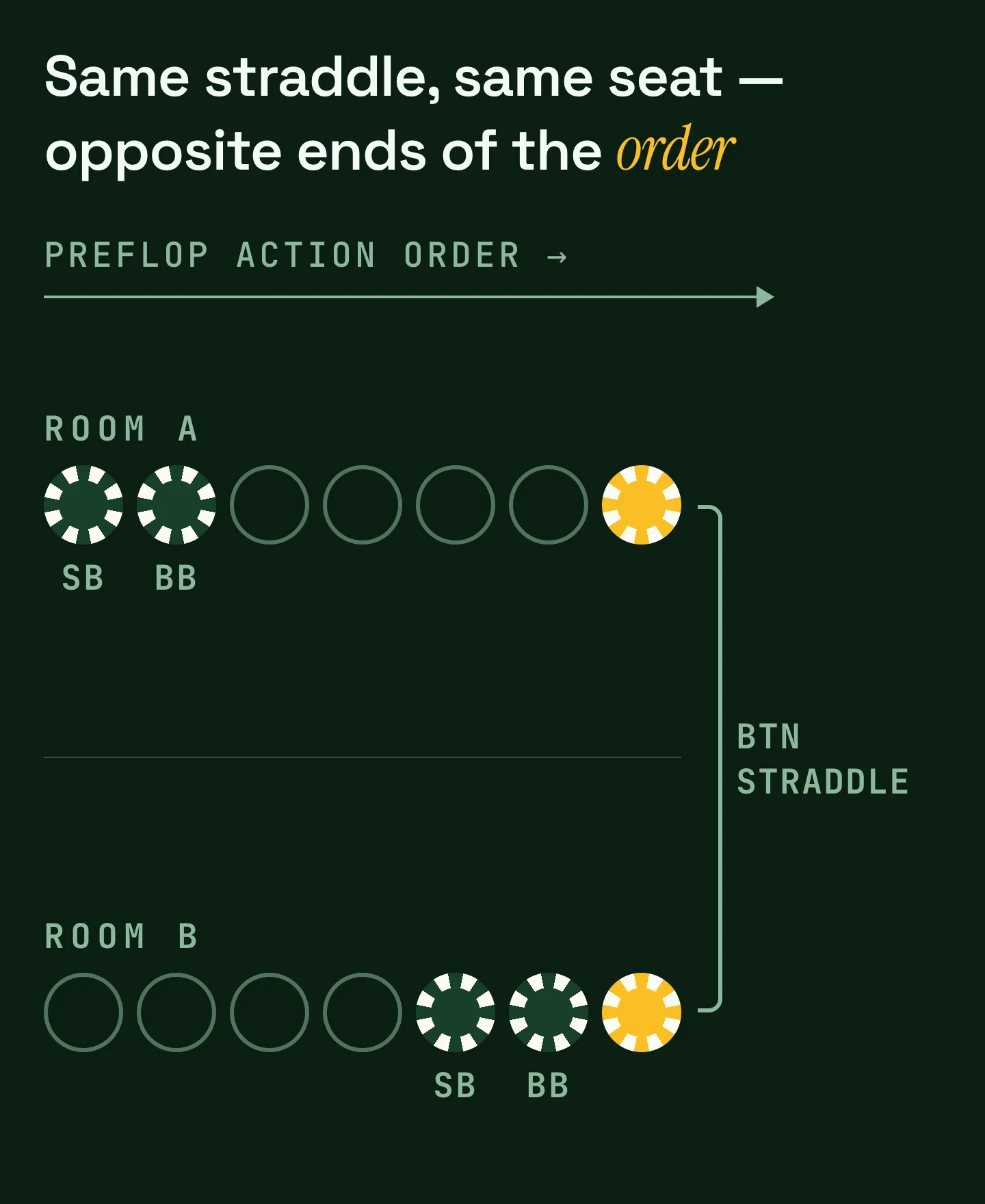
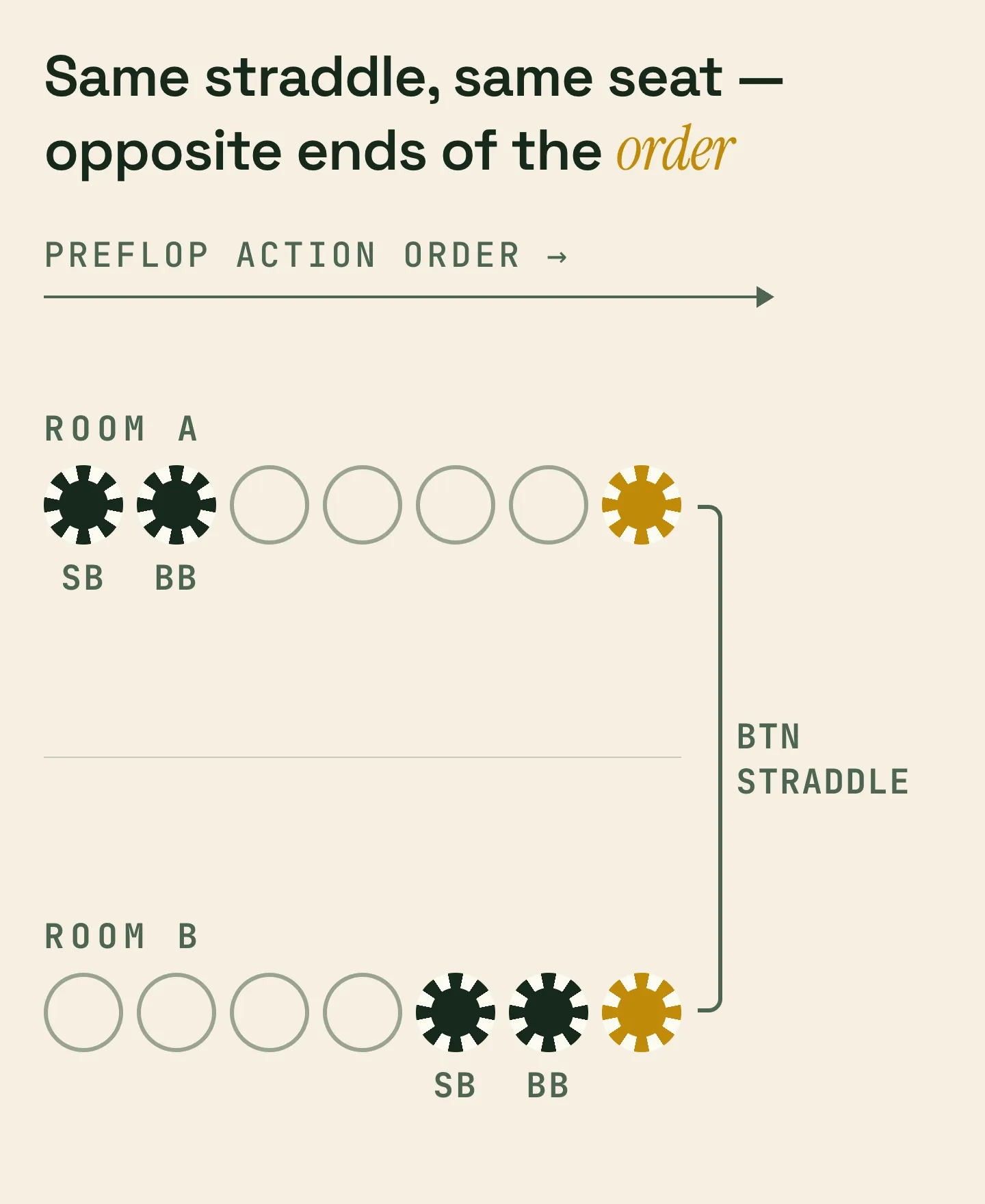
Two rooms, two answers to “whose turn is it?” — which is why it’s a question for the dealer, not for a glossary.
In a third game, an under-the-gun player straddled, and that one behaved much more like a third blind — it sits immediately left of the big blind, so the action simply starts to its left.
Same word. Different rules.
A couple of times I had to be told that the action was on me, because I was expecting someone else to act — particularly when I was in the blinds and the button had straddled. So if you sit down in a game where someone straddles and you’re not sure how the action works, ask the dealer.
Minimum raise: the rule that fooled me
For a beginner, the word raise sounds simple enough.
Then someone says “minimum raise” and suddenly the arithmetic gets weird.
The mistake I used to make was assuming that a raise had to double the current bet. It doesn’t.
A raise has to go up by at least as much as the last raise went up. Say you’re in a $1/$3 game and someone opens to $12. That’s a $9 increase over the $3 big blind. So the minimum re-raise is another $9 on top — to $21. Not $24, which is what doubling would give you.
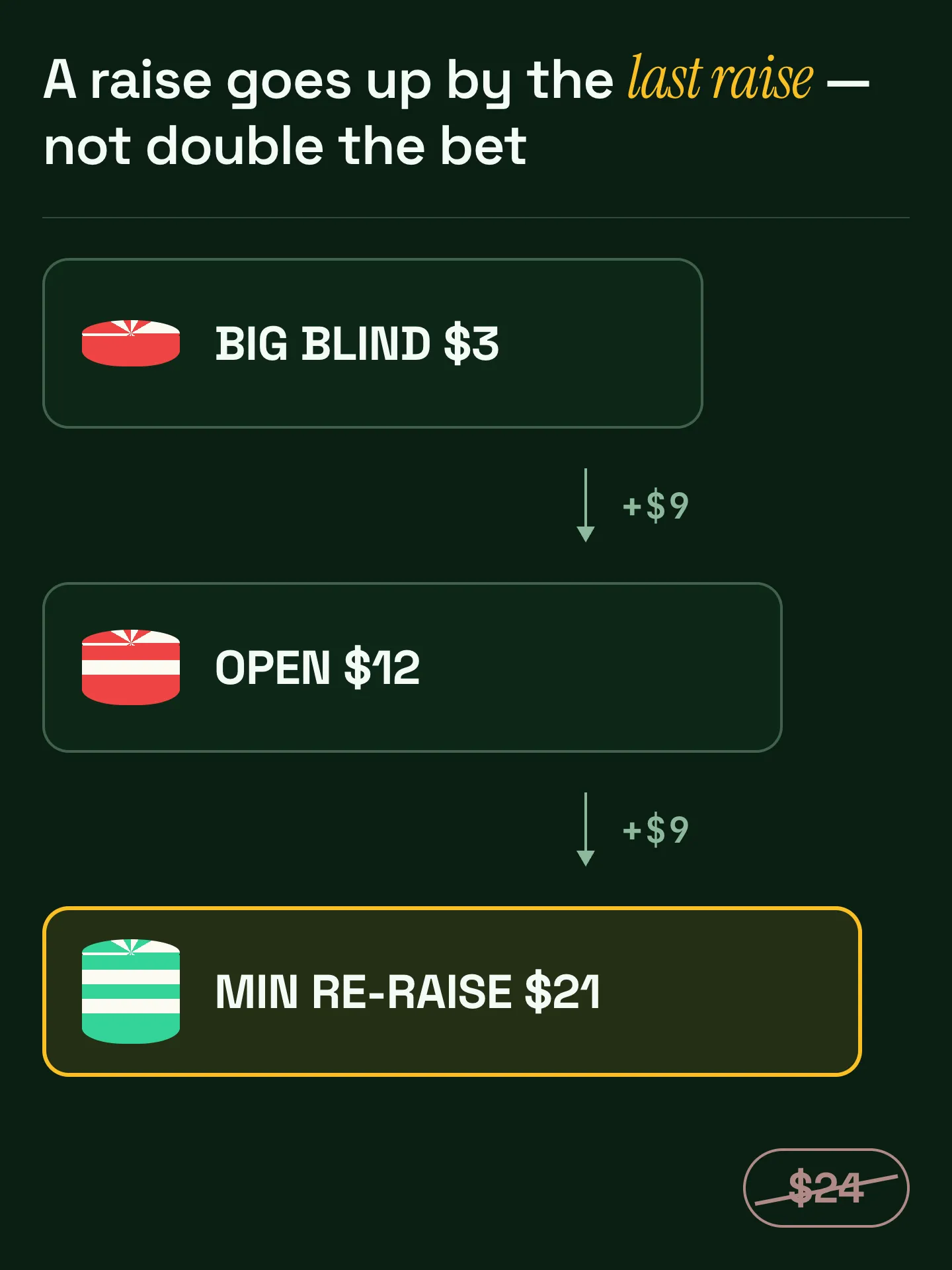
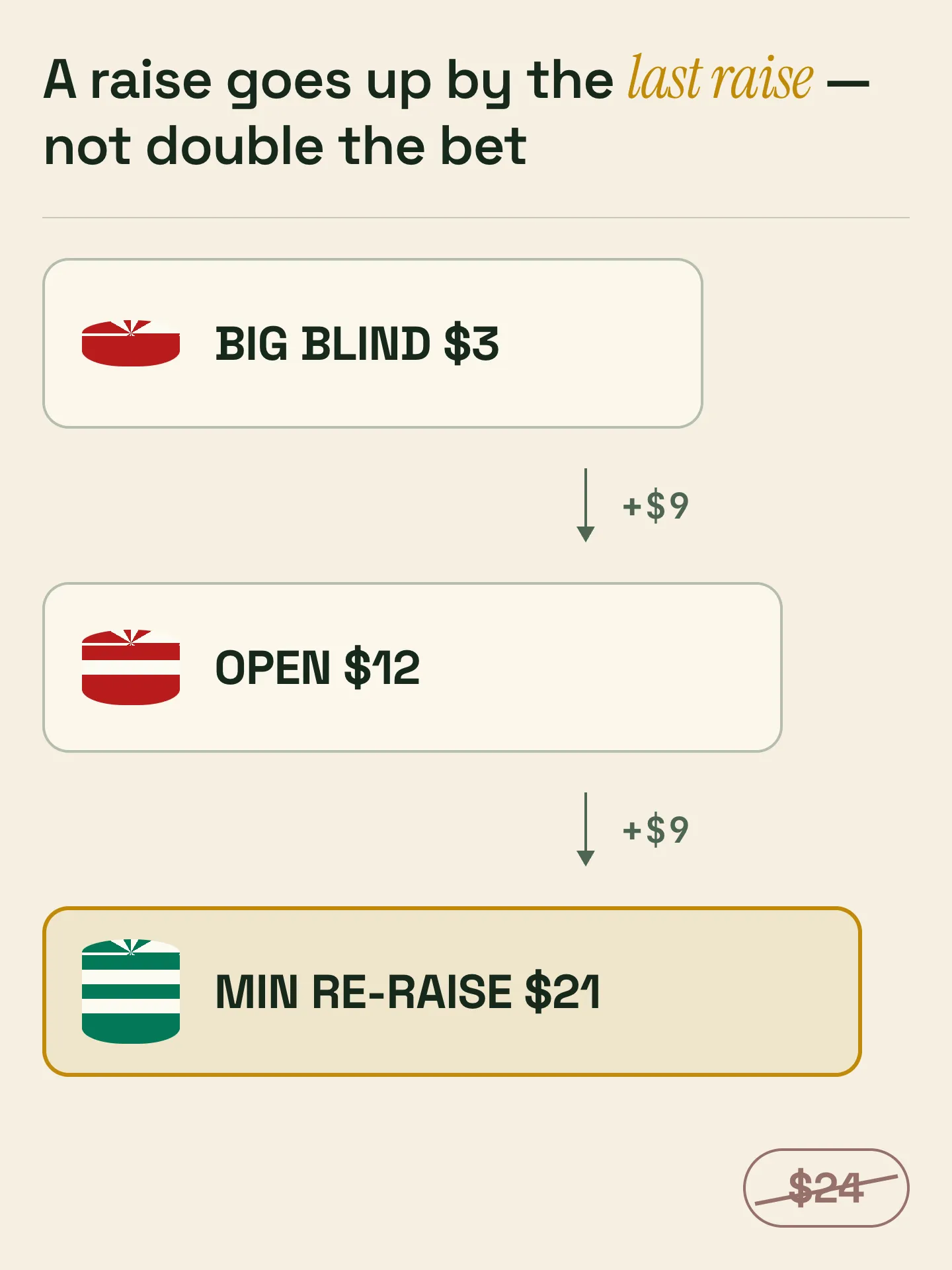
The increment is what repeats, not the total. $9 in, $9 on top.
The same rule covers the case you’ll hit most often, where nobody has raised yet. The big blind is $3, so the smallest legal raise is another $3 on top — to $6.
It works identically at bigger stakes. Say the blinds are $5/$10 and someone opens to $35. That’s a $25 increase over the $10 big blind, so the minimum re-raise is another $25 — to $60. I used to think it had to be $70, because I was thinking in terms of doubling the $35.
It doesn’t. $60 is enough.
If you do try to raise less than the minimum, the dealer will stop you and tell you the correct amount — you won’t be allowed to make an illegal raise by accident. But it’s a slow, conspicuous way to find out, and it’s worth knowing the arithmetic before you’re the one holding up the table.
When an all-in doesn’t reopen the betting
Another rule I learned by getting it wrong at the table.
Suppose someone bets $15, and a short stack goes all-in for $20. That’s only $5 more — less than the $15 it would take to make a full raise.
If you’ve already acted in that round, that all-in doesn’t reopen the betting for you. You can call the extra $5. You can’t raise.
The flip side catches people out the other way: if you haven’t acted yet in that round, a short all-in doesn’t restrict you at all. You can still raise.
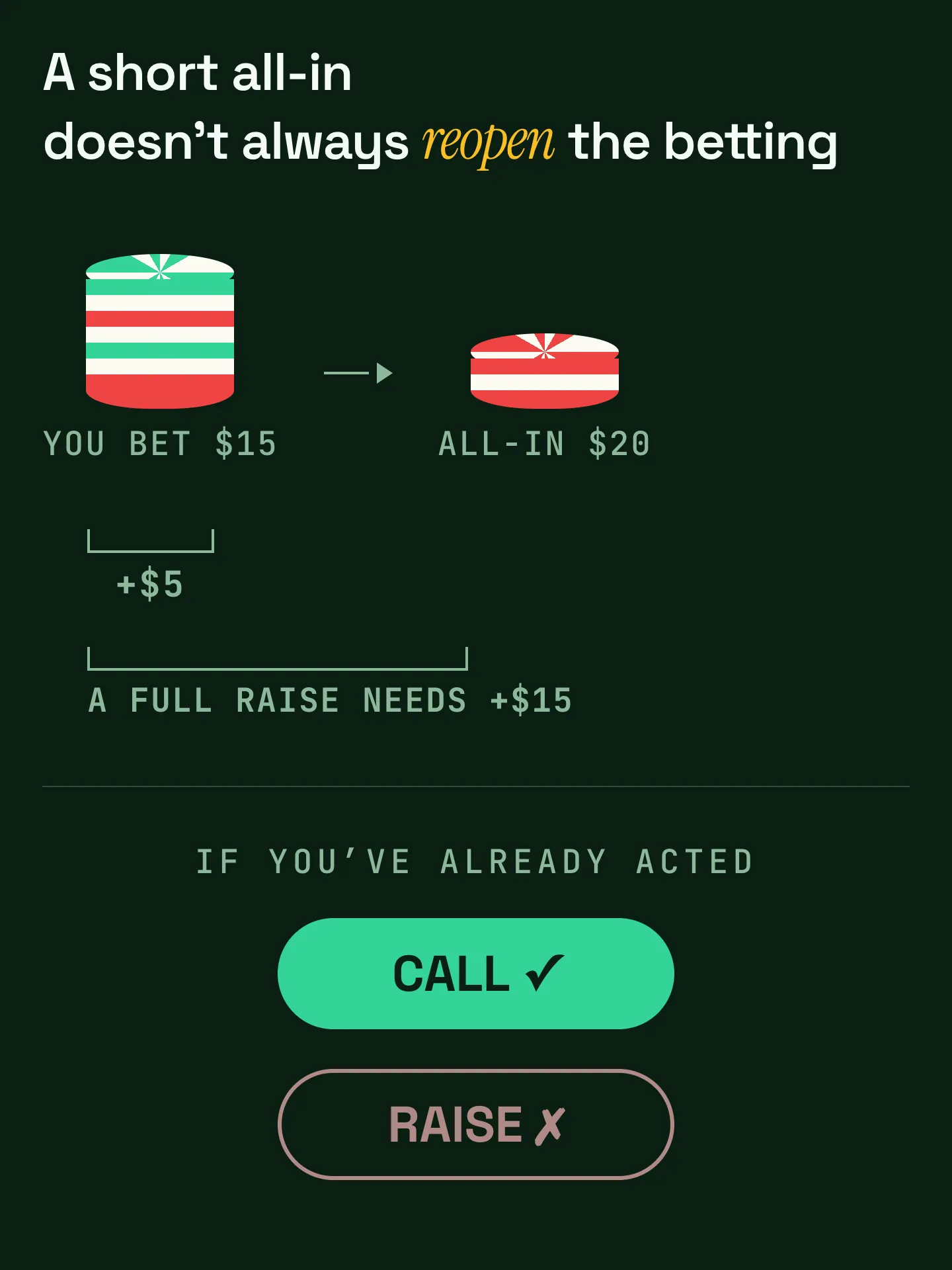
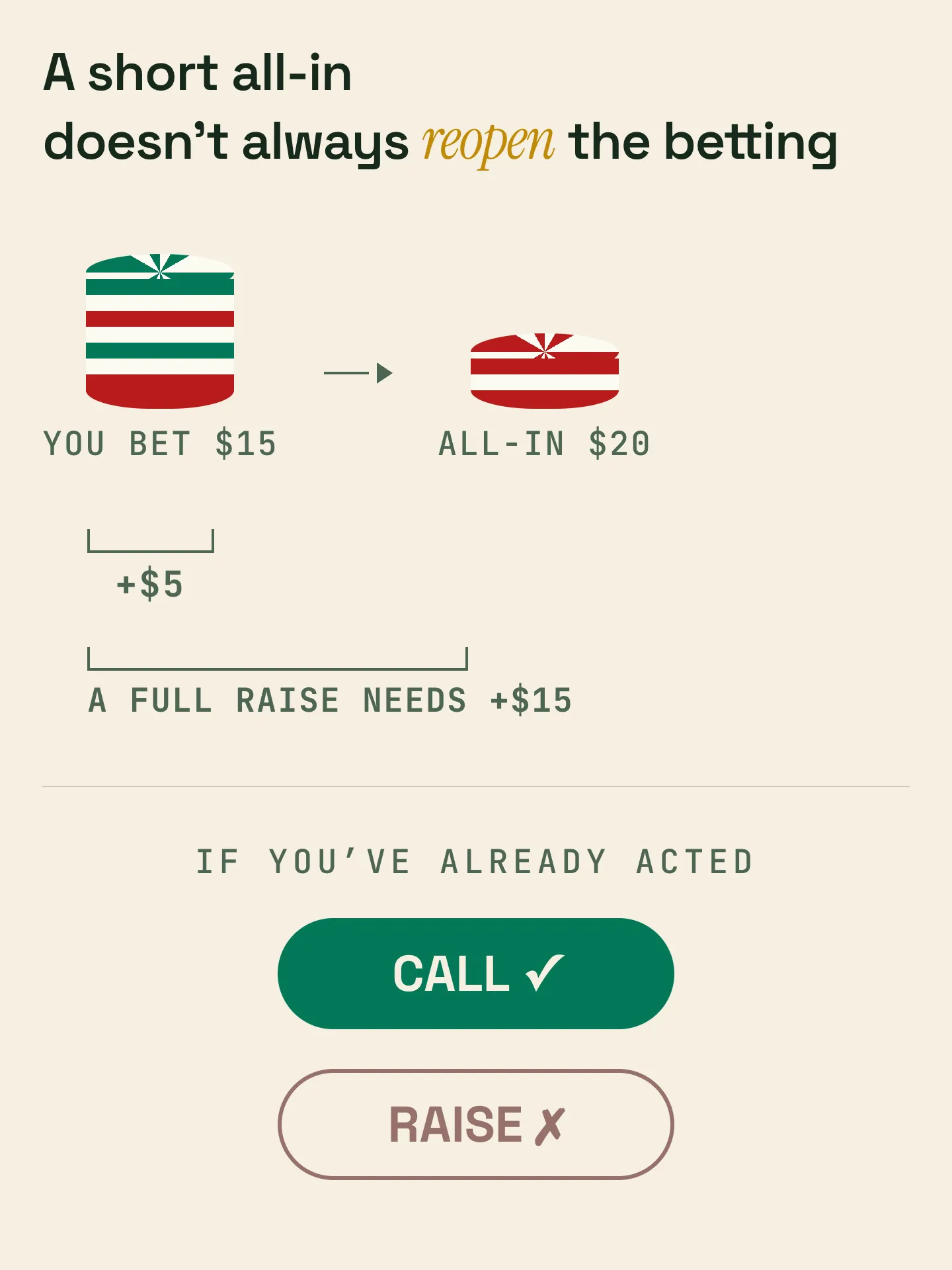
If you haven’t acted yet in that round, none of this applies to you — you can still raise.
This happened to me.
A player went all-in and I tried to re-raise all-in. I couldn’t, because the all-in hadn’t been large enough to constitute a full raise and reopen the action to me.
The embarrassing part wasn’t that I didn’t know the rule.
It was that I tried to make a raise I wasn’t allowed to make.
That attempt itself gave information away about my hand. The other player still in the hand then folded.
I knew what “all-in” meant. What I didn’t know was what the situation permitted. And the information leaked out through the action I wasn’t allowed to take.
If you’re ever unsure whether the action is open to you, ask the dealer before you touch your chips.
Asking is also the answer to most of the other procedural things a casino throws at you on your first visit, which I wrote about in the chip rules a home game never taught me.
Table stakes: you play the chips in front of you
Live cash games are table stakes, which means the only money in play is what’s already on the table when the hand starts. You can’t reach into your pocket mid-hand and pull out more.
This one catches home-game players constantly, because a lot of kitchen-table games let you dig for cash when you’re short.
The practical consequence: if someone bets more than you have in front of you, you aren’t forced out. You’re all-in for whatever you’ve got, and any money the other players keep betting goes into a side pot that you can’t win.
You can add chips between hands as much as you like. If you hand the dealer cash for more chips, they’ll announce that you’re playing behind — that money counts as part of your stack for the next hand, not the one being dealt.
What you can’t do is the reverse. Chips don’t come off the table while you’re in the game — you can’t bank a good session by pocketing half your stack and carrying on with the rest. If you want to take money off, you leave.
Showdown: who has to show first
When the last bet is settled and more than one player is still in, somebody has to turn their cards over first. There’s an order to it.
If there was a bet on the river and someone called it, the player who bet shows first. The caller gets to see that hand before deciding whether to show their own.
If nobody bet on the river — everyone checked it down — the first player to act shows first, and it moves around the table from there.
And when someone is all-in with no betting left to come, the all-in player’s hand goes face up. There’s nothing left to bet, so there’s nothing left to protect.
The order matters because whoever shows last has a small edge: if they’ve lost, they can muck without anybody seeing what they had.
There’s also an etiquette rule sitting on top of the procedure. If you know you have the winner, turn it over. Taking your time to reveal a monster after the other player has already shown is called a slow roll, and it’s the one thing at a live table that will genuinely annoy people.
One spot where I don’t stand on the order: if I’ve called someone’s river bet and they say “you’re good” without turning their hand over, technically they’re the one who has to show. I’ll usually just table my hand rather than make them show a busted bluff.
What to carry into your next session
The rules worth carrying in:
- A straddle changes the order of action — and which order depends on the room. Ask the dealer before you post one.
- A minimum raise goes up by the last raise’s increment, not double the last bet.
- A short all-in that isn’t a full raise doesn’t reopen the betting for anyone who has already acted. You can call the extra. You can’t raise.
- Table stakes means you play the chips in front of you. No reaching into your pocket mid-hand.
- At showdown, the player who bet shows first — or the first player to act, if it was checked down.
I eventually learned that I didn’t need to know every poker rule before sitting down. There will always be some unusual situation you’ve never seen before, especially when you start playing in different rooms.
The useful distinction is knowing when a question actually matters. If someone is talking about a hand and uses a term you don’t know, you can always look it up later. But if you’re sitting there wondering whether it’s your turn, whether you can raise, or how much you’re allowed to put in, ask the dealer.
Afterwards is when a hand is worth a second look. That’s what I built HeroCall for — you describe what happened in plain English, the way you’d tell a friend: “Short stack shoved for $20 over a $15 bet and I couldn’t re-raise.” No structured hand entry, no dropdowns.
And if you haven’t already, it’s worth going back to the basic poker terminology guide. Once the everyday vocabulary becomes second nature, you’ll have a much easier time recognizing the few terms that actually change what happens at the table.