Live Poker Terms for Beginners: The Words You'll Actually Hear at the Table
During my last visit home, I finally convinced my parents to learn poker. After hearing me talk about the game for years, they gave in, so I taught them the rules, put a hand-ranking chart on their phones, and we started playing with a stash of coins standing in for poker chips.
They picked up the flow of the game pretty quickly. The funny part was that they understood what was happening in the hands, but whenever I started using poker terms to explain something, I would get a blank look. They understood the idea. They just didn’t know the words.
I had the same experience when I taught my brother-in-law and his fiancée. It got me thinking about how much poker vocabulary I had picked up over the years without really noticing it. So this is a guide to the words you’ll actually hear at a poker table, especially when you’re starting to play live. You don’t need to know every bit of poker slang before you sit down. You just need enough of the language to know what everyone is talking about.
And once you know the basic vocabulary, there’s another small group of poker terms like straddles and minimum raises worth learning — the ones that aren’t just words, but rules in disguise. I’ve covered those separately in poker terms that are really rules.
The poker vocabulary you need before you sit down
Let’s start with the words that will come up constantly.
Hole cards and the board
Your hole cards are the cards dealt face down to you. In Texas Hold’em, you get two, and only you can see them.
The community cards are the cards dealt face up in the middle of the table. Everyone can use them to make their best five-card hand.
You’ll hear players call the community cards the board. So if someone says, “I had pocket kings and the board came A-Q-7,” they’re simply telling you about their two private cards and the community cards.
Preflop, flop, turn and river
A Hold’em hand has four betting rounds, and each has its own name.
Preflop is before any community cards are dealt. You have your two hole cards and nothing else. The flop is the first three community cards, the turn is the fourth, and the river is the fifth and final one. Collectively, these are often called the streets.
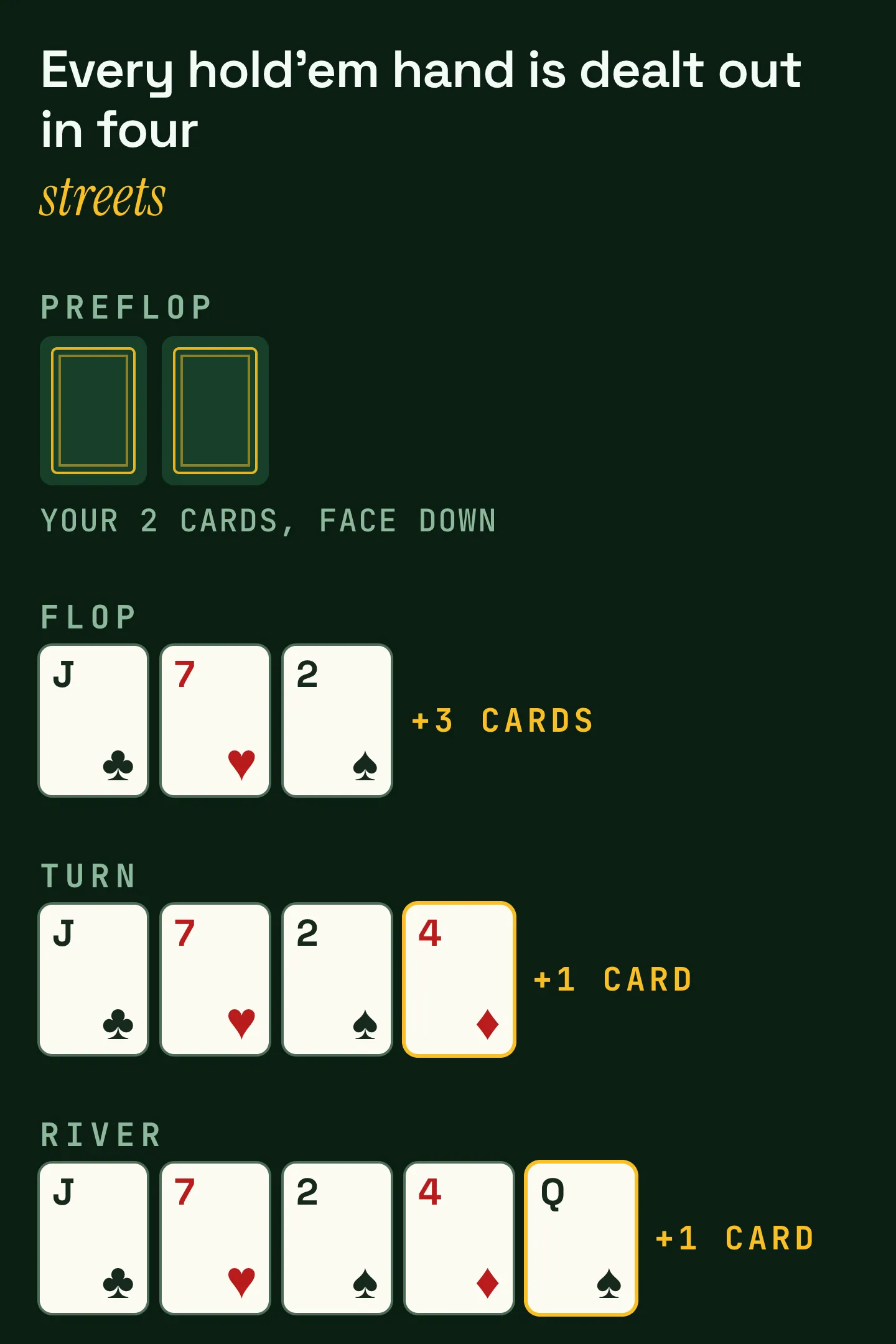
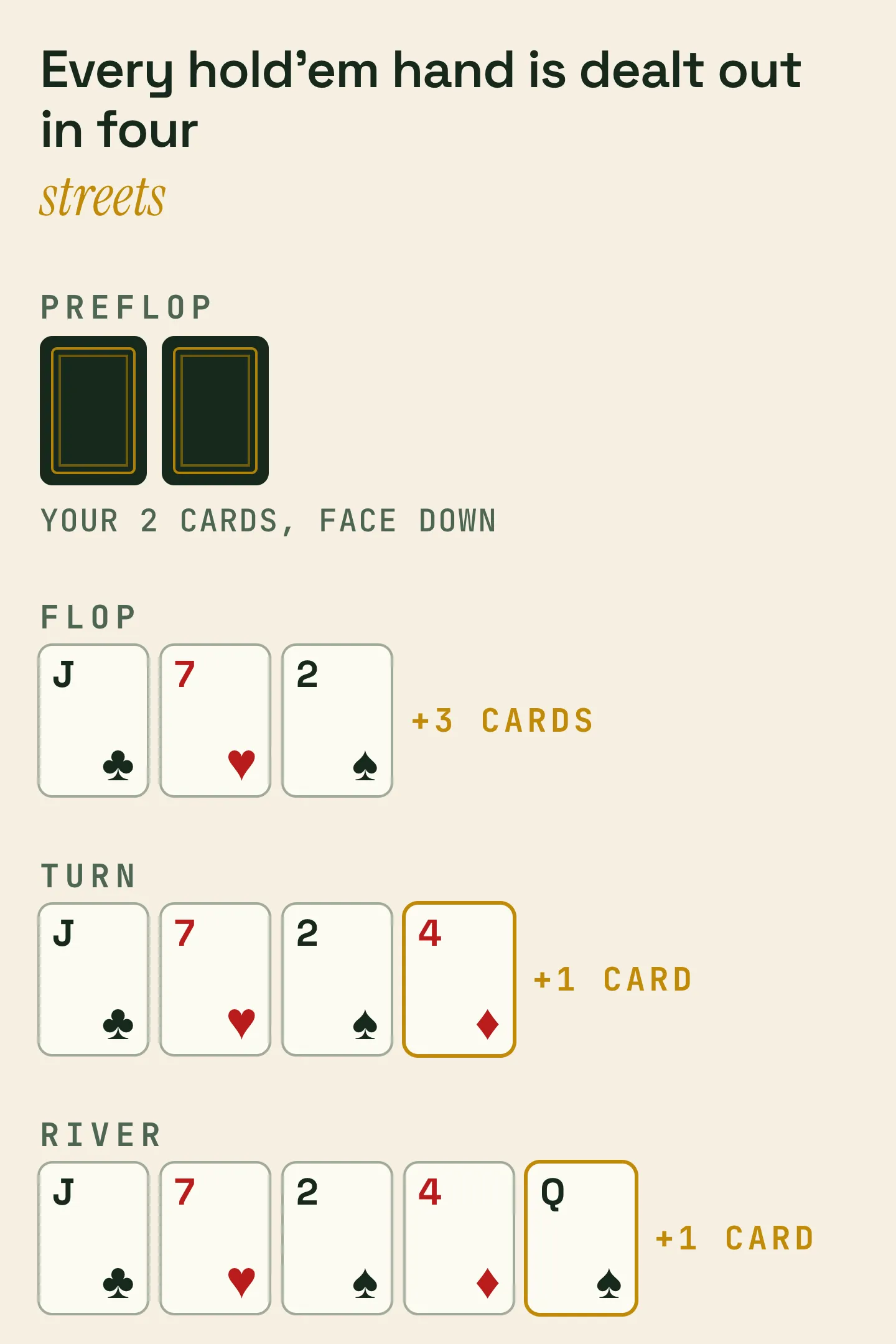
The board only ever grows. Each street adds cards to what is already there.
So when someone says, “I got there on the river,” they’re saying the final community card completed their hand. When someone says, “He bet all three streets,” they mean the player bet the flop, turn and river.
Those are the kinds of phrases that can sound like another language when you’re new. Once you’ve heard them a few times, they become completely ordinary.
Blinds, antes and the pot
The small blind and big blind are forced bets posted before the cards are dealt. In a $1/$3 game, the small blind is $1 and the big blind is $3. That’s what the two numbers in the game’s name refer to.
The blinds move around the table from hand to hand, so everyone pays them over time.
An ante is another forced bet, but instead of being posted by just the blinds, it is generally posted by everyone. You’ll see antes much more often in tournaments than in low-stakes live cash games.
The pot is simply the money in the middle that everyone is competing for.
Action, position and the basic betting moves
There are four basic things you can do when the action gets to you:
- Fold — give up your hand.
- Check — put no more money in when there is no bet to call.
- Call — match the current bet.
- Bet — put money into the pot when nobody has bet yet.
And then there is raise: increasing the amount that another player has already bet.
You’ll also hear action constantly at a live table. If the dealer says, “Action’s on you,” it simply means it’s your turn to make a decision.
You’ll hear players talk about position too. Being in position means you will generally act after your opponent; being out of position means you act first. That order is set by the button — the small disc that moves one seat clockwise after every hand. The button acts last on every betting round after the flop, which is why players want to be “on the button.” The action moves the same way — clockwise, one seat at a time.
The two seats to its left post the blinds: the small blind, then the big blind. And the seat immediately left of the big blind is under the gun — first to act before the flop, which is the hardest seat to play from because everyone acts after you. You’ll also hear the seat just before the button called the cutoff.
So position isn’t a mysterious quality some players have. It’s just where you’re sitting relative to that disc, and it changes every single hand.
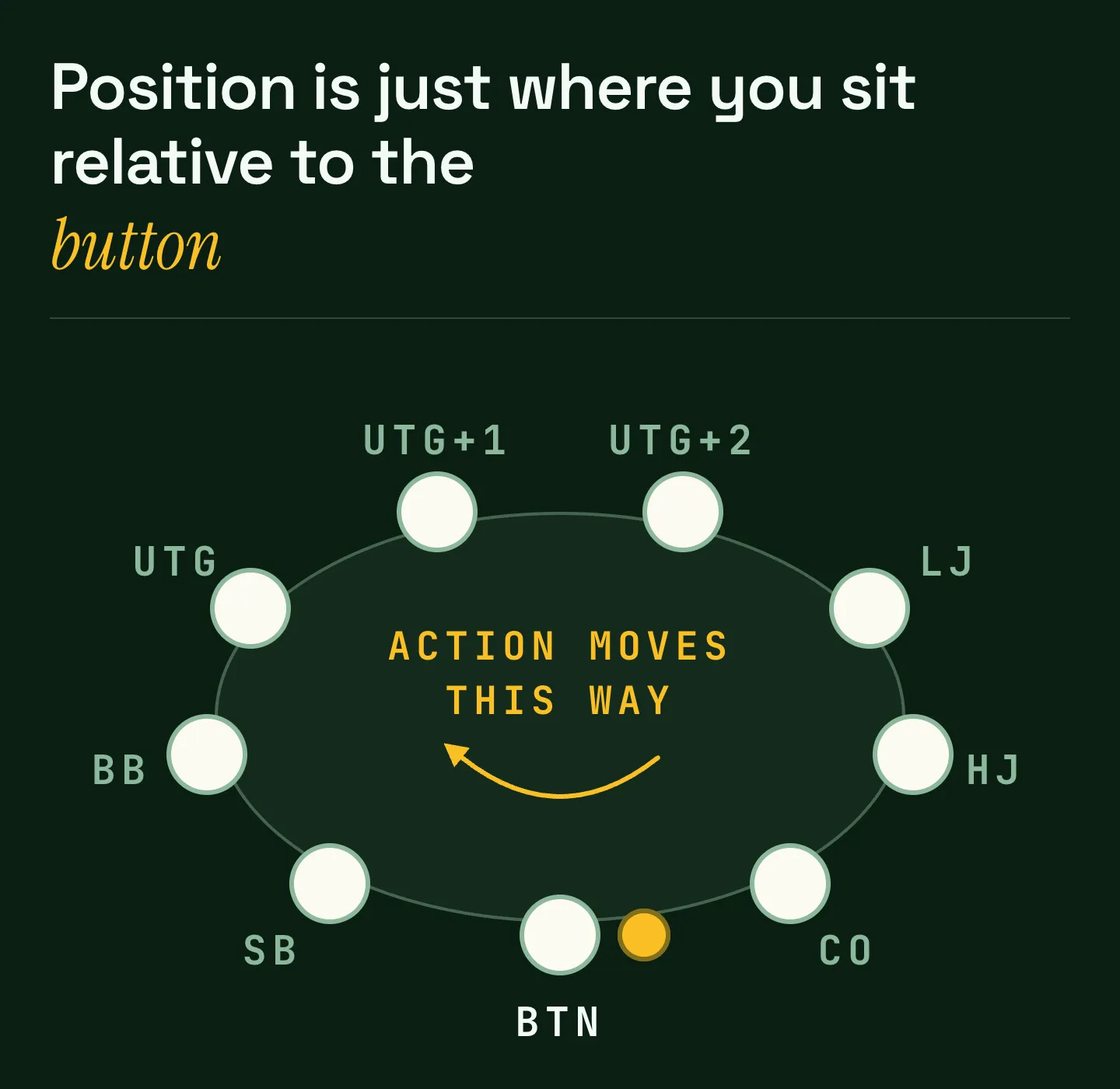
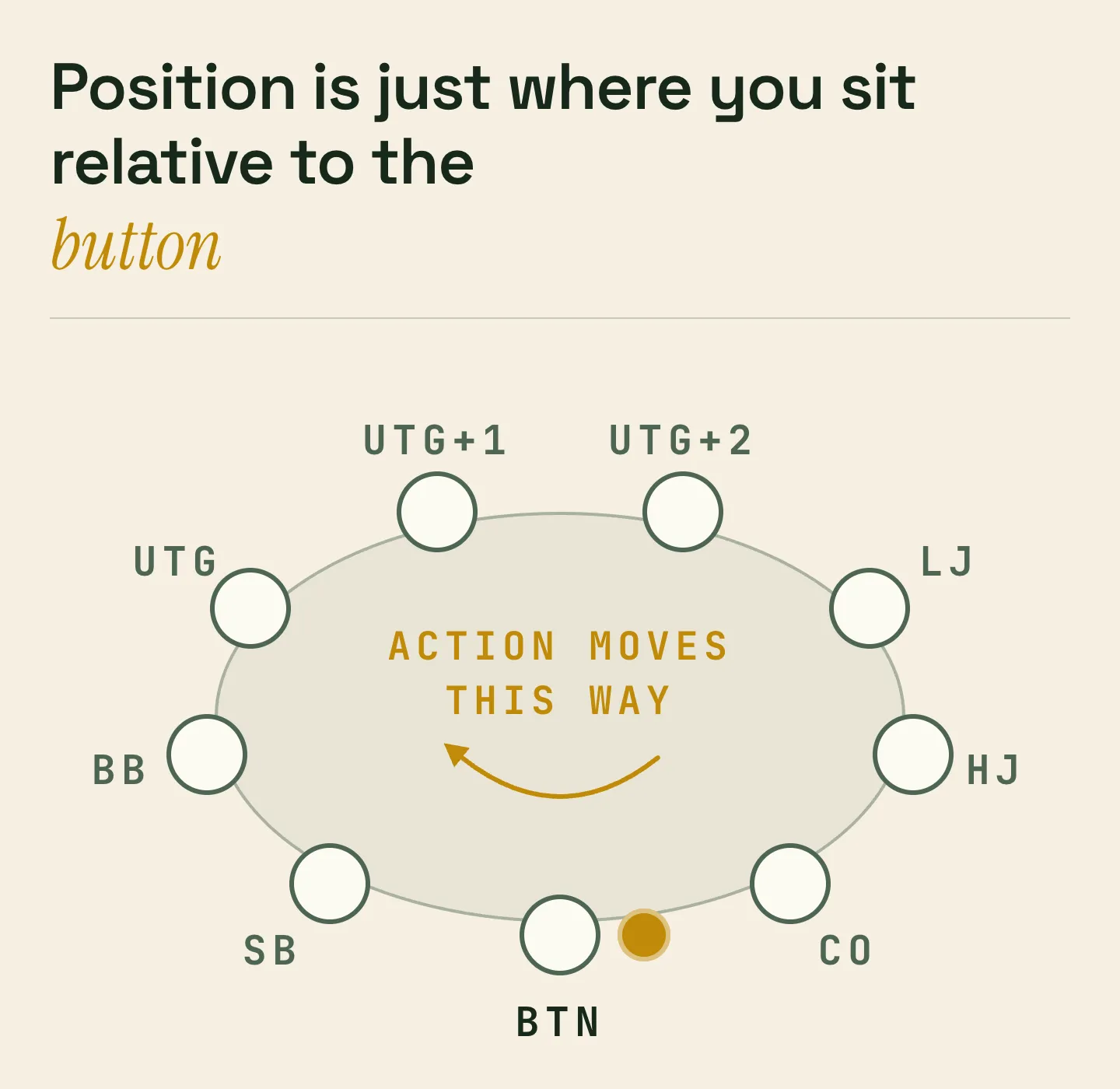
The button moves one seat clockwise every hand, and every other name moves with it.
You don’t need to understand all the strategy behind position before you play your first hand. But you should know what people mean when they say, “I had position on him.”
Another word you’ll hear constantly in low-stakes live games is limp. If a player simply calls the big blind before the flop rather than raising, they have limped into the pot. That player is a limper.
Open, 3-bet and 4-bet
You’ll hear open, 3-bet and 4-bet constantly once you start listening to poker conversations.
An open raise, usually shortened to just open, is the first raise before the flop.
For example, in a $1/$3 game, someone raises to $12. That’s the open. If another player raises again — say to $40 — that’s a 3-bet. If the original raiser comes back again, to $110, that’s a 4-bet.
Players count the big blind as the first bet, so the first raise is technically the 2-bet. Almost nobody says it out loud, and in practice you can forget it.
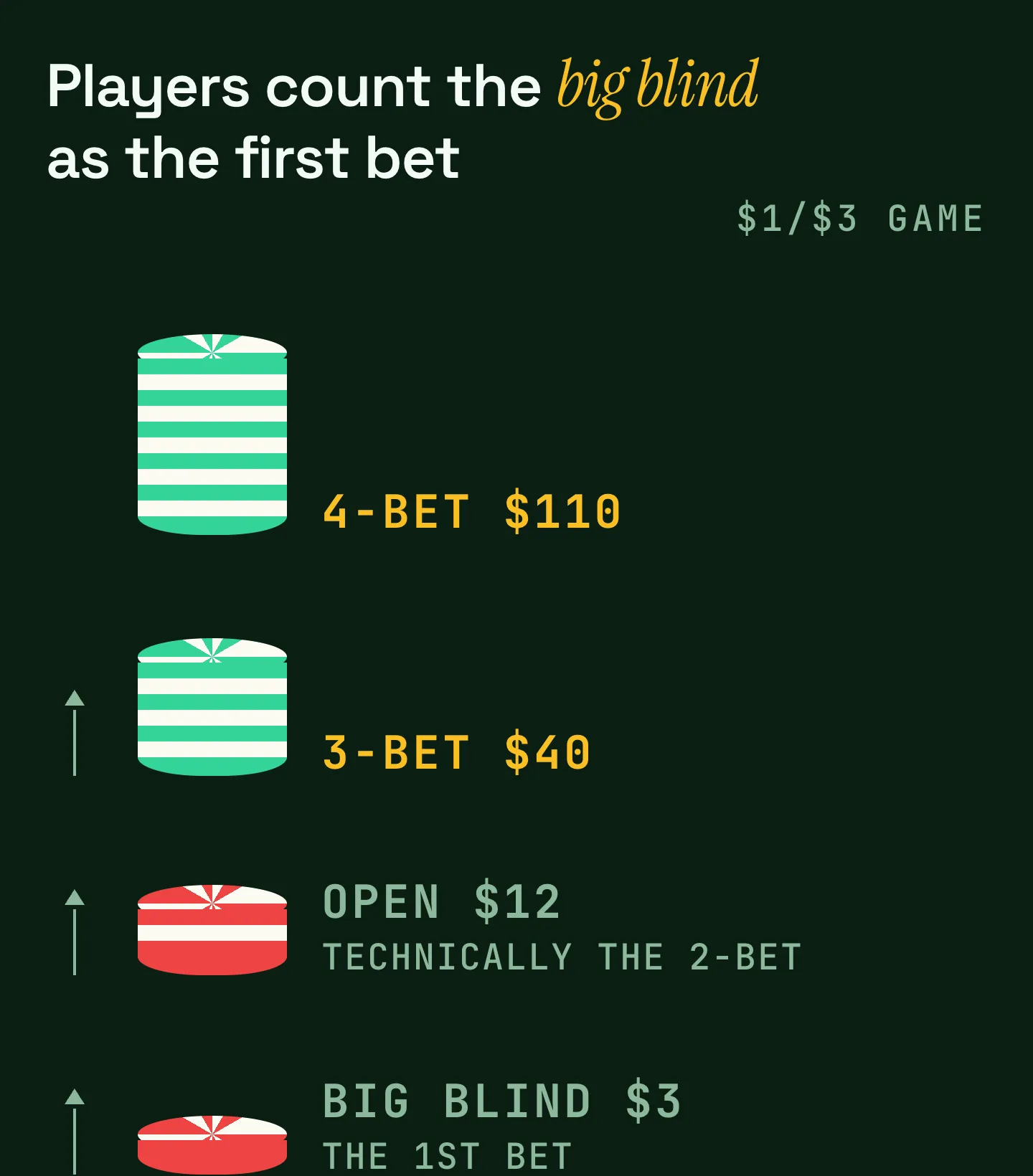
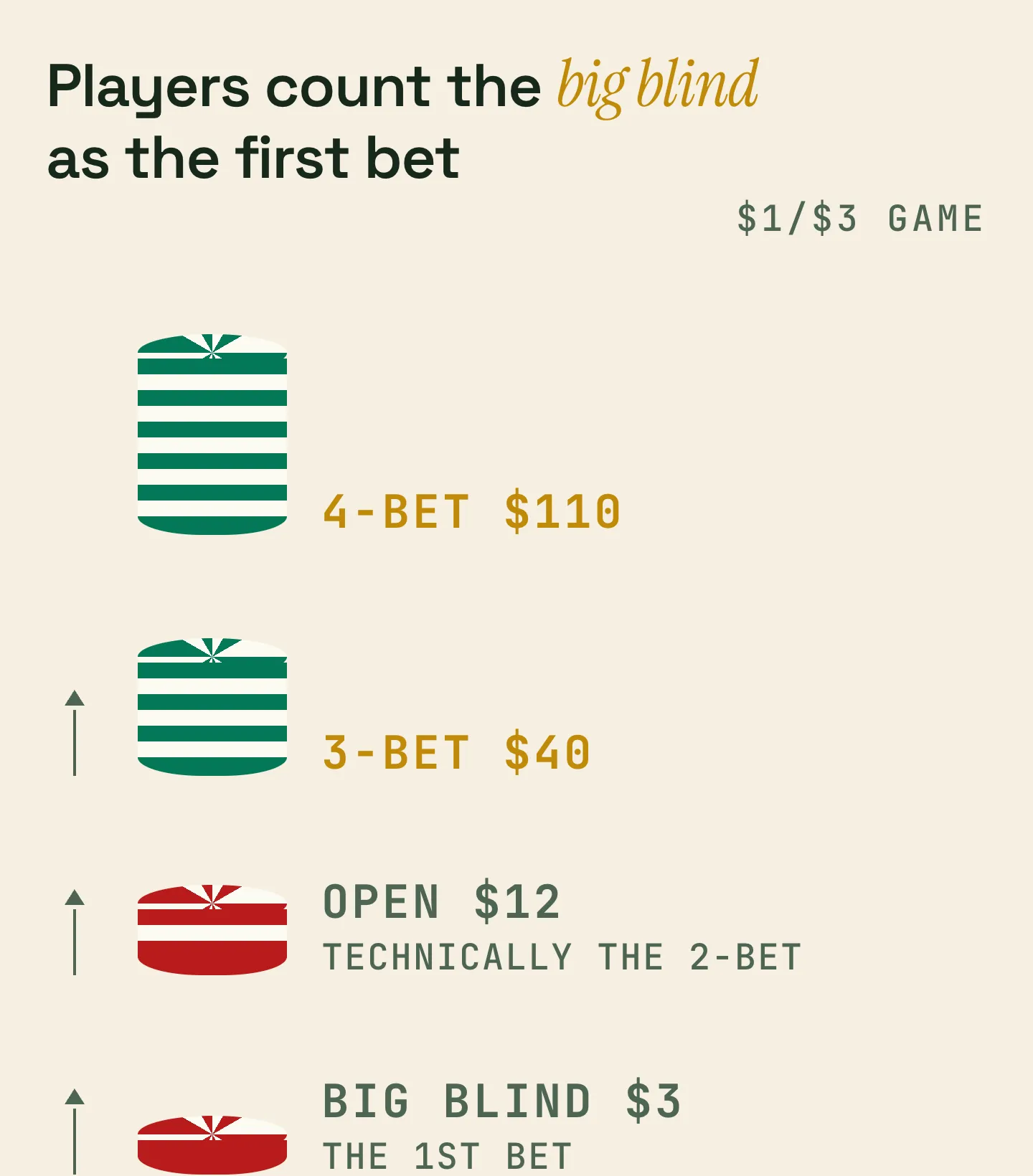
Nobody says “2-bet” out loud. That is the only reason the counting looks off by one.
The useful sequence to remember is:
open → 3-bet → 4-bet → 5-bet
So when someone says, “I 3-bet him and he 4-bet me,” they’re simply saying:
He raised, I re-raised, and he re-raised again.
Check-raise: a sequence, not a single action
A check-raise is exactly what it sounds like: you check, your opponent bets, and you raise their bet in the same betting round. If someone says, “He check-raised me on the turn,” they’re describing that sequence.
Jam, shove and ship
There are several different ways poker players say all-in. Jam and shove both mean betting your entire remaining stack, and you’ll also hear ship used in the same sense.
So:
“He jammed the river.”
and
“He shoved the river.”
mean essentially the same thing.
Gutshot, open-ender, backdoor and outs
Once people start talking about hands after the fact, you’ll hear a different group of terms.
A gutshot is an inside straight draw. You need one specific rank to complete the straight.
For example, with 9-8 on a J-7-2 board, a ten completes your straight.
An open-ended straight draw, often shortened to open-ender, can be completed at either end. With 9-8 on a A-7-6 board, a ten or a five completes the straight.
A backdoor draw is different because you need both remaining community cards to complete it.
For example, if you have three cards of the same suit between your hole cards and the flop, you can have a backdoor flush draw. You need the turn and river to bring that suit.
Then there are outs. Outs are cards that can improve your hand, often by completing your draw. A basic gutshot has four straight outs, while an open-ender has eight.
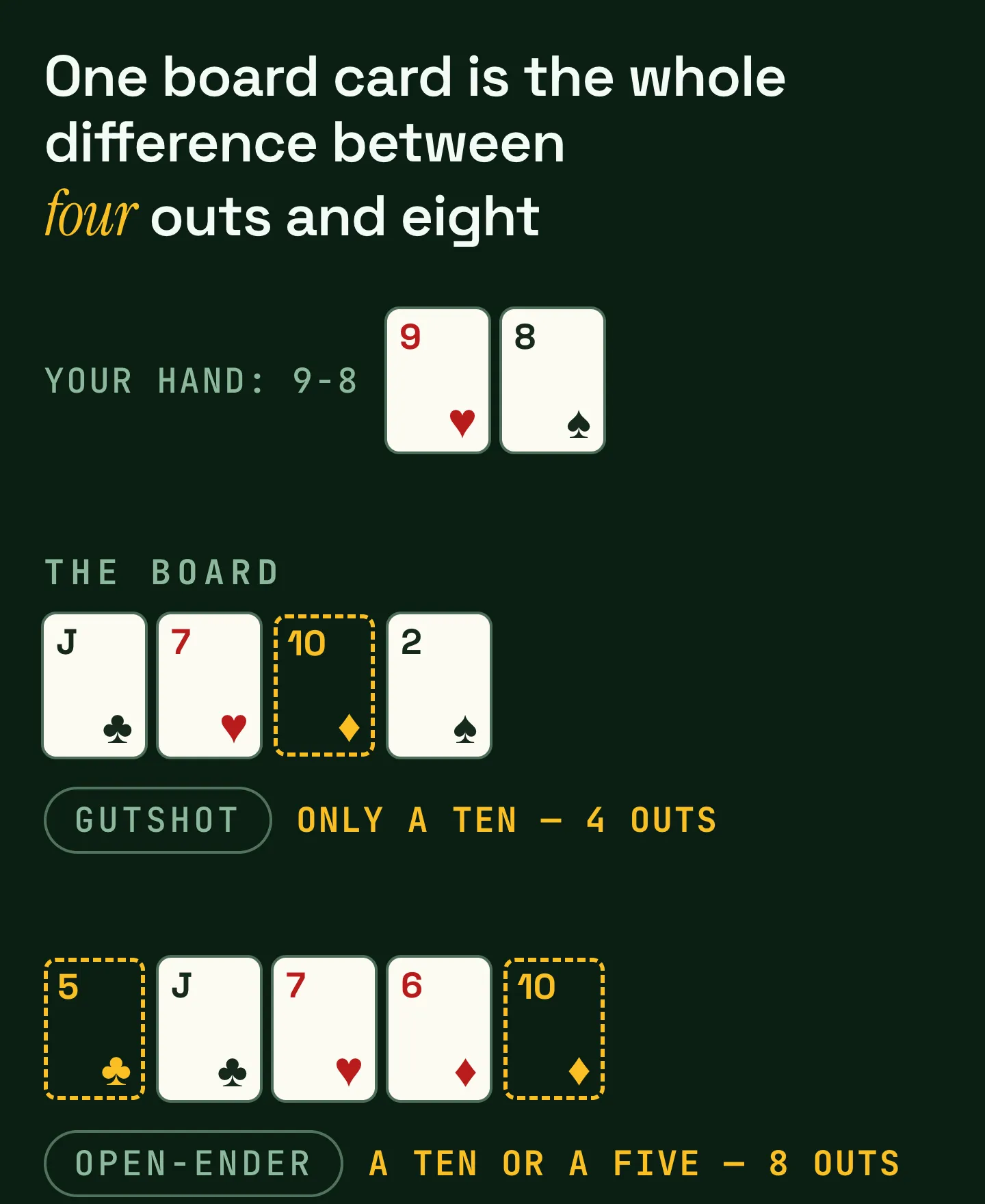
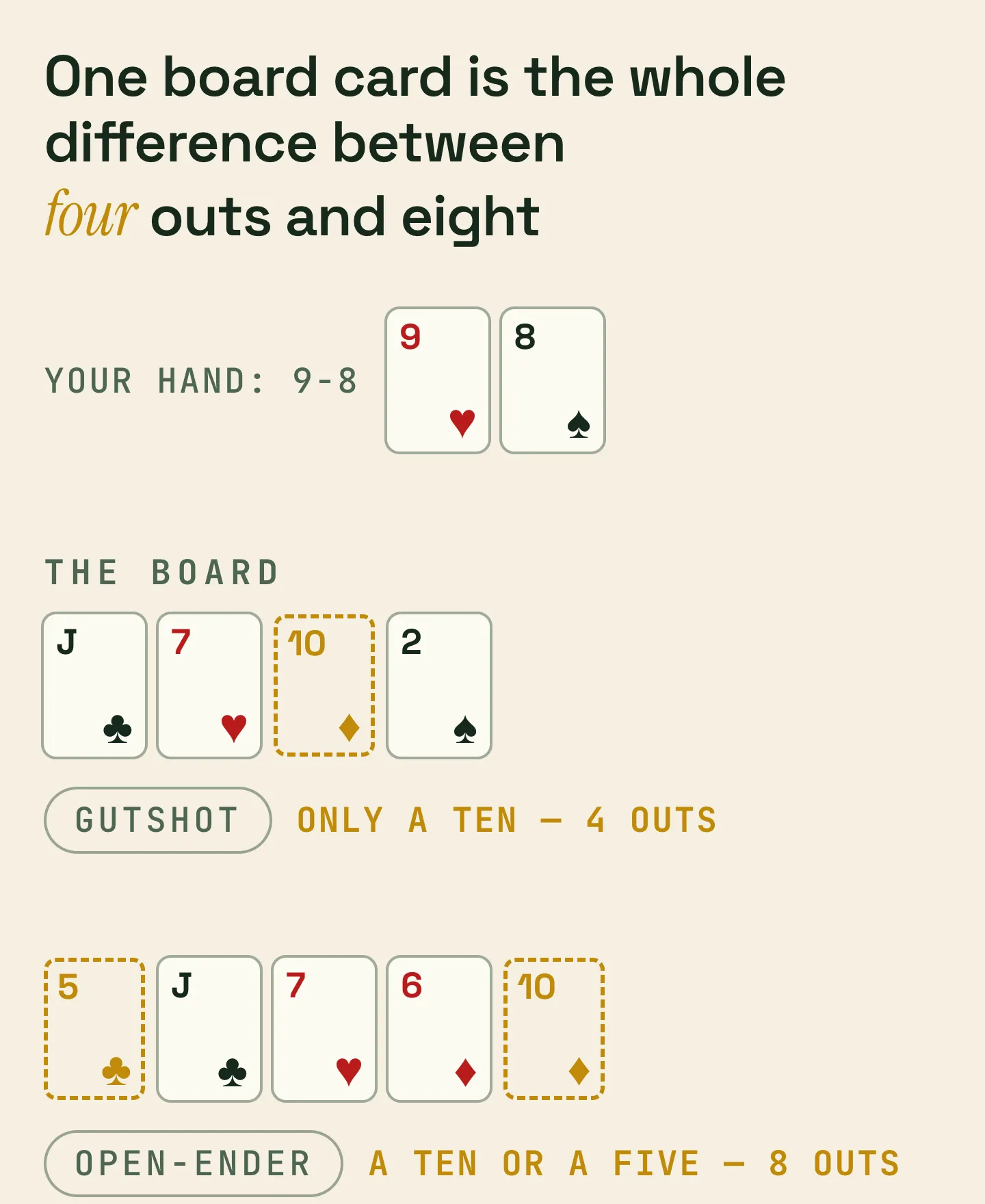
Same two cards in your hand. The board decides whether you have four outs or eight.
You’ll hear people say things like:
“I had a gutshot and a backdoor flush draw.”
At first, that sentence sounds like somebody is deliberately trying to make poker sound complicated.
It’s not. They’re just describing the ways their hand could improve.
And unlike the terms in the second half of this, these don’t change what you’re allowed to do. They’re mostly vocabulary that makes it easier to talk about a hand.
Equity, range, the nuts and showdown
These are four words that sound more advanced than they really are.
Equity
Equity is your estimated share of the pot based on the possible outcomes, usually expressed as a percentage. If you have roughly a 25% chance of winning a pot, you have about 25% equity.
You don’t need to calculate it yourself at the table to understand what people mean when they use the word.
Range
A player’s range is the collection of hands they could have in a particular situation. This is one of the most important poker words to understand, because good players don’t think only about one hand their opponent might have. If someone says, “His range is really strong here,” they mean the collection of hands that player could reasonably have contains a lot of strong hands.
The nuts
The nuts is the best possible hand given the cards on the board. If someone says, “I had the nuts,” they’re saying that, at that moment, they had the strongest possible hand that could be made.
The important phrase is “given the board.” The nuts changes as the board changes.
Showdown
Showdown is when the remaining players reveal their cards at the end of the hand and determine who wins.
You’ll hear things like:
“He took it down without a showdown.”
That simply means everyone else folded before the cards had to be revealed.
What if you don’t know a poker term at the table?
This is probably the most useful thing I can tell a new live player:
You don’t need to know everything before you sit down.
I certainly didn’t. I learned a lot of poker terminology at the table, but I rarely learned the actual definitions at the table. I’d hear something I didn’t understand, make a mental note of it, and look it up afterwards. I still think that’s a perfectly reasonable way to learn. There is one important exception.
If the term or situation affects what you’re about to do, ask the dealer. If someone straddles and you’re not sure whose action it is, ask. If an unusual all-in happens and you’re not sure whether you can raise, ask. If you don’t know what the dealer is asking you to do, ask.
The chip-handling rules that actually catch people out on a first casino visit — single chips, string bets, keeping your cards protected — I wrote up separately in what a home game never taught me.
If someone tells a story after the hand and uses three poker terms you don’t know, you can look them up when you get home. And when you do, it’s useful to write down the actual situation rather than just the word.
It’s also the reason HeroCall works the way it does. I wanted to review my hands by describing them the way I’d describe them to a friend, rather than filling in a structured hand-entry form — which means you can write down what happened without needing the word for it.
I could always remember what happened in a hand. I didn’t always know the poker terminology for it.
I might remember:
“The guy in front of the button went all-in and I couldn’t raise.”
That’s a perfectly good description of the situation even if I don’t know the technical term for it. And I think that’s an important part of learning poker.
You don’t need to know the language before you can understand the game. The language just gives you a much easier way to talk about what you’re already seeing.
What to know before your first live session
Know your hole cards, board, streets, blinds, position and basic actions.
Know what an open, 3-bet, check-raise and all-in mean.
And understand the few terms that can actually hide a rule — especially straddles, minimum raises and short all-ins.
Everything else can come one hand at a time.
That was the part I didn’t appreciate when I started playing live poker. The vocabulary looked intimidating because there was so much of it. In reality, most of it was just vocabulary.
The next thing I wish I’d understood was that some poker terms do more than describe what’s happening. They can actually tell you what you’re allowed to do. If you’re getting ready to play live, the guide to those rules is a good one to read next.